Merge Master: Dinosaur Monster
- 4.2
- Rating
- 100.00M
- Installs
- Free
- Price

 Analysis by App-foxy
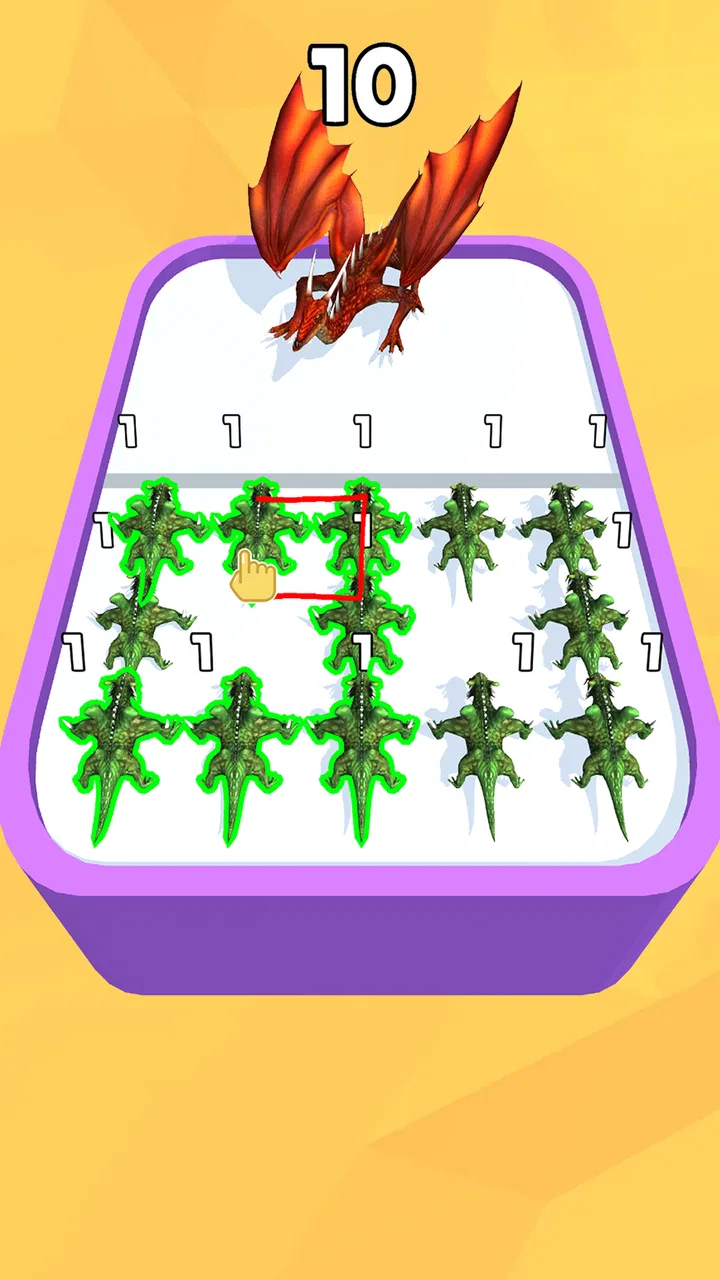
I approached Merge Master: Dinosaur Monster expecting a quick arcade distraction, and that is exactly where it works best. Its central idea is easy to understand: combine dinosaur units, build a stronger force, and send them into battles that feel more like compact tactical puzzles than a full strategy campaign. The appeal comes from the speed of the loop. I can make a few decisions, watch the result, and start another round without needing a long tutorial or a large time commitment.
That simplicity is also the game’s defining limit. This is not the right choice if you want a deep dinosaur-management simulation, a carefully written adventure, or a strategy game with a huge number of systems to master. It is a lightweight arcade game from Homa, designed around immediate choices and repeated battles. After spending time with it, my view is straightforward: it is enjoyable for short sessions, especially when I want something visual and uncomplicated, but players looking for lasting strategic complexity may move on quickly.
How the merge-and-battle loop feels in practice
The first thing that makes the game approachable is how little preparation it demands. The basic action is familiar even if you have never played this particular title: matching or combining units gives you a more capable dinosaur, and the resulting lineup is used in a fight. That creates a satisfying before-and-after moment. I begin with a modest group, make a few merges, and immediately see whether those decisions have produced a useful formation.
You May Also Like

 Blood Strike: 2.5 Anniversary
Blood Strike’s Loadouts Turn Every Drop Into a Tactical Gamble
A close look at Blood Strike’s custom loadouts: how fast access to signature weapons reshapes its battle royale rhythm, rewards preparation, and narrows the gap between fights.

 Pandora - Music & Podcasts
Pandora’s Music Is Easy to Start, but Harder to Recover
Pandora’s strength is its low-effort path from a seed to a station. Its weak spot is how much confidence it asks you to place in connection, setup, and quiet recovery.

 8 Ball Pool
 Is Built on Rivalries, Rematches, and Routine
A close look at the rivalries, rematches, shared routines, and unanswered safety questions that turn a quick pool match into a persistent mobile community.

 Samsung Music
’s Quiet Strength Is Playing What You Already Own
Its reach comes less from spectacle than from dependable access to a personal library. That simplicity is both the app’s strongest retention engine and its ceiling.

 AccuWeather: Weather Radar
AccuWeather Review: A Quick, Clear Forecast for Everyday Decisions
For everyday plans, the best forecast is the one you can understand quickly. AccuWeather makes rain timing, radar, and local conditions easy to act on, with a few trade-offs.

 Hill Climb Racing
Why Hill Climb Racing Still Turns Crashes Into One More Run
A tiny car, a bumpy hill and one more upgrade: Hill Climb Racing keeps resurfacing because its simple chaos makes every near-miss feel personal.
More From Our News Desk
View All News


The battles are best understood as short tests of preparation. The interesting part is not simply watching dinosaurs collide; it is deciding when a merge is worth making and when keeping several separate units gives me better coverage. A stronger individual creature can be tempting, but combining everything too early can leave gaps in the lineup. That trade-off gives the otherwise simple arcade format a little more thought than a purely automatic battle.
My most useful habit was to pause mentally before every merge instead of combining units as soon as the option appeared. I looked at the whole board, considered whether I needed several bodies or one stronger attacker, and then committed. This small change made the game feel less like tapping through prompts and more like solving a quick positioning problem. It is a practical tip for new players because the best move is not always the biggest-looking dinosaur.
The game’s dinosaur theme does a lot of the presentation work. The creatures are immediately readable, and the idea of building a monster army gives each upgrade a clear visual purpose. I never needed complicated explanations to understand that a more advanced unit should have a better chance in the next encounter. That clarity is valuable on a phone, where a game often competes with interruptions and limited attention.
At the same time, the loop can become predictable. Once I understood the general rhythm of merging, arranging, and watching the fight, the surprise came mostly from the outcome rather than from new forms of play. Players who enjoy repeating a compact action until they improve will likely find that comfortable. Players who need constant mechanical change may find the structure too narrow.
The small decisions that matter most
The strongest part of the design is the tension between immediate power and flexible numbers. Merging creates a clear upgrade, but it also changes the shape of the force I am preparing. I found that it helped to think in terms of the next encounter rather than treating every available combination as an automatic improvement. That approach is particularly useful when a battle seems close, because preserving options can be more valuable than chasing a single impressive unit.
Another helpful approach is to use the early part of a session as a test rather than trying to play perfectly. I could see which arrangement survived longer, notice where the opposing force was creating pressure, and adjust on the next attempt. This makes failure less frustrating. Instead of seeing a lost battle as wasted time, I treated it as information about how aggressively I had merged.
There is also a useful distinction between playing for progress and playing for a few minutes of entertainment. When I wanted a quick break, I accepted imperfect choices and enjoyed the spectacle. When I wanted to improve, I slowed down and paid attention to the relationship between unit count, upgrade timing, and the battle result. The same simple system supports both moods, although only the second approach reveals most of its limited tactical depth.
The game rewards restraint as much as aggression. That is the non-obvious lesson I would pass on to a friend. A new player may assume that the largest available dinosaur is always the correct answer, but a balanced group can be more useful when the encounter demands several targets or when one unit alone cannot absorb enough pressure.
What makes it convenient for everyday play
I see this as a good fit for short, interrupted sessions. A realistic example would be waiting for a coffee, sitting on public transport, or taking a brief break between tasks. I can open it, make a few choices, and stop without needing to remember a complicated story or rebuild a large strategy plan. That low commitment is one of its clearest strengths.
The game is free to play, which makes trying it easy. It is rated Everyone 10+, so it is aimed at a broad audience while still carrying an age classification above the youngest children. In-app purchases range from $0.99 to $99.99 per item, and that spread matters when deciding whether to keep spending. I would begin with the free experience and only consider a purchase after deciding that the repeating merge-and-battle loop genuinely suits me.
That advice is not a criticism of the game’s basic concept; it is about matching spending to the type of enjoyment on offer. A short arcade loop can be entertaining without becoming a long-term hobby. I would avoid buying anything impulsively during a frustrating run, because the desire to overcome one difficult moment is not the same as enjoying the game’s overall structure.
For device compatibility, the game supports Android 7.0 and later. Its current version is 3.49.0, so anyone using an older Android device should check compatibility before planning around it. I appreciate that the entry requirement is not tied to a recent Android release, because that gives the game a wider practical audience than many newer mobile titles.
Where the design starts to feel thin
The meaningful weakness is repetition. The opening is easy to enjoy because the merge action, dinosaur theme, and battle result create immediate feedback. After that first impression settles, the same core decision has to carry the experience. If new situations do not feel different enough, the player can start making the same choices automatically.
I also found that the game’s simplicity can make losses feel less instructive than they should. In a deeper strategy title, a defeat may clearly reveal a mistake in economy, positioning, timing, or team composition. Here, the explanation can feel more compressed: I know that my preparation was not strong enough, but there may be less detail about exactly why. That is acceptable for an arcade game, yet it limits how much I can learn from each attempt.
This is where the game compares unfavorably with more elaborate alternatives in the strategy and puzzle space. A traditional tower-defense game usually gives me more control over placement and enemy response. A deeper merge game may offer more collection planning, resource management, or long-term progression choices. A dinosaur simulation may focus on habitats, breeding, or management rather than quick combat. Merge Master: Dinosaur Monster sits on the accessible end of that spectrum: faster to understand, easier to pick up, and less demanding, but also less rich.
That comparison helps clarify who should skip it. If your priority is a campaign with a strong narrative, detailed tactical control, or a large collection system that stays fresh for many weeks, I would choose a different category or a more complex alternative. The dinosaur theme alone will not turn this into a simulation. It is better approached as an arcade battle game that uses dinosaurs to make its upgrades and clashes immediately appealing.
There is a second trade-off in the visual feedback. Watching a stronger creature emerge is satisfying, but repeated upgrades can become routine when the decision behind them is obvious. I preferred sessions where I deliberately experimented with timing, because simply taking every available merge reduced the feeling of participation. The game is at its best when I make the board my problem to solve, not when I treat it as a sequence of buttons.
Who will get the most from it
I would recommend this game to someone who likes casual arcade games with a clear objective and a small amount of tactical thinking. It is especially suitable for players who enjoy the emotional rhythm of combining weaker pieces into stronger ones, then seeing whether the new arrangement can win. The dinosaur setting adds personality without requiring the player to learn a complicated world.
It also works for people who want a low-pressure introduction to merge mechanics. The rules are approachable, and the battle feedback makes the result easy to understand. A younger player within the Everyone 10+ rating may enjoy the creatures and quick action, while an adult can use it as a short distraction. I would still recommend that families pay attention to the in-app purchase range, particularly if the device is shared.
More experienced strategy players may enjoy it as a palate cleanser rather than a main game. I can imagine alternating between a demanding tactics title and this one when I want something that does not require full concentration. Its value in that role comes from its accessibility, not from offering a substitute for a deeper game.
The game has attracted a substantial audience, with over 100 million installs and a 4.2 average from around 618 thousand ratings. Those figures suggest that the straightforward formula has broad appeal, although popularity does not remove the central question of personal tolerance for repetition. I would interpret the response as evidence that the concept is easy to pick up, not as a guarantee that every player will want to continue for a long time.
It has also received around 1.9 thousand written reviews, which gives prospective players another reason to look beyond the first few minutes. My own advice is to judge it after several ordinary sessions rather than after one unusually lucky battle. The important test is whether you still enjoy deciding when to merge once the novelty of the dinosaur presentation has settled.
Practical advice before committing to it
Start by treating each board as a limited planning space. Before combining units, identify whether the next fight seems to reward one powerful creature or a broader group. This prevents the most common beginner mistake: merging automatically because the game makes the upgrade visually attractive. I found that waiting a moment often produced a more useful formation.
Second, use a loss to change one decision at a time. If I changed every part of the lineup after a defeat, I could not tell what had helped. Keeping most of the setup stable while adjusting merge timing made the result easier to read. That is a simple method, but it gives the game more strategic texture than rushing through repeated attempts.
Third, decide what kind of session you are having. For a quick break, play freely and accept that not every result needs optimization. For a longer session, experiment with conservative merges and compare the outcome. The game does not need to become a serious strategy project, but it becomes more satisfying when my play style matches my goal.
Finally, keep the purchase model in mind. Because the title is free and individual in-app purchases can reach $99.99, I would not use spending as a substitute for learning the merge rhythm. If the basic loop is not enjoyable without help, a purchase is unlikely to solve the deeper issue. If the loop is enjoyable, the free experience is the sensible place to begin.
My final recommendation
Merge Master: Dinosaur Monster is a focused arcade game with an appealing premise and an unusually accessible entry point. Homa has built the experience around a clear pleasure: combine dinosaurs, make a stronger force, and see whether your preparation holds up in battle. I like that I can understand the objective quickly, but still find small decisions about timing and balance when I choose to play thoughtfully.
Its limitations are just as clear. The tactical layer is compact, the battle rhythm can become repetitive, and the game does not replace a full strategy campaign or a detailed dinosaur simulation. Those are not reasons to dismiss it; they are reasons to approach it honestly. I would skip it if I wanted deep systems or a story-led adventure, but I would recommend it to a friend looking for a free, pick-up-and-play dinosaur game with a little more decision-making than a purely passive arcade experience.
Released on November 5, 2021, it remains a sensible choice for short mobile sessions, particularly on Android devices running version 7.0 or later. My verdict is positive but measured: try it for the merge-and-battle loop, stay if the quick tactical choices remain fun, and do not expect the simplicity to turn into a full strategy game.
FAQs for Merge Master: Dinosaur Monster
01What is the main objective of Merge Master: Dinosaur Monster?
The main objective of Merge Master: Dinosaur Monster is to strategically merge dinosaurs and monsters to create stronger units. Players are tasked with overcoming various levels and challenges by merging their creatures to form formidable teams capable of defeating enemies and progressing further in the game.
02Is Merge Master: Dinosaur Monster free to play?
Yes, Merge Master: Dinosaur Monster is free to download and play. However, it does offer in-app purchases that can enhance gameplay by providing additional resources or removing ads. Players can enjoy the game without making purchases, but spending money can speed up progress.
03What platforms is Merge Master: Dinosaur Monster available on?
Merge Master: Dinosaur Monster is available for both Android and iOS devices. You can download it from the Google Play Store for Android or the Apple App Store for iOS. Ensure your device meets the necessary specifications for optimal performance.
04Are there any age restrictions for playing Merge Master: Dinosaur Monster?
Merge Master: Dinosaur Monster is suitable for players aged 12 and above. The game features mild cartoon violence as players merge and battle with dinosaurs and monsters. Parents should review the content to ensure it aligns with their standards before allowing younger children to play.
05How can I get better at Merge Master: Dinosaur Monster?
To improve in Merge Master: Dinosaur Monster, focus on strategy and planning. Regularly merge your creatures to strengthen your team, and pay attention to enemy patterns to effectively counter them. Participating in challenges and events can also offer rewards that enhance your gameplay experience.
Pros
- Engaging and addictive gameplay loop.
- Wide variety of dinosaurs to merge.
- Visually appealing graphics and animations.
- Frequent updates with new content.
- Easy to learn for all age groups.
Cons
- In-app purchases can be expensive.
- Ads can be intrusive during gameplay.
- Requires internet connection to play.
- Progression can be slow without spending.
- Some features feel repetitive over time.

Merge Master: Dinosaur Monster
Gallery